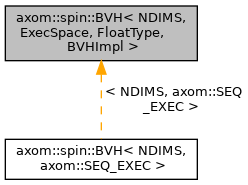
|
| | BVH () |
| | Default constructor. More...
|
| |
| template<typename BoxIndexable > |
| | BVH (const BoxIndexable boxes, IndexType numItems, int allocatorID=axom::execution_space< ExecSpace >::allocatorID(), FloatType tolerance=DEFAULT_TOLERANCE, FloatType scaleFactor=DEFAULT_SCALE_FACTOR) |
| | Constructs a BVH instance of specified dimension over a given set of geometric entities, each represented by its corresponding axis-aligned bounding box. More...
|
| |
| template<typename BoxIndexable > |
| int | initialize (const BoxIndexable boxes, IndexType numItems) |
| | Initializes a BVH instance of specified dimension over a given set of geometric entities, each represented by its corresponding axis-aligned bounding box. More...
|
| |
| bool | isInitialized () const |
| |
| void | setAllocatorID (int allocatorID) |
| | Sets the ID of the allocator used by the BVH. More...
|
| |
| int | getAllocatorID () const |
| | Get the ID of the allocator used by the BVH. More...
|
| |
| void | setScaleFactor (FloatType scale_factor) |
| | Sets the scale factor for scaling the supplied bounding boxes. More...
|
| |
| FloatType | getScaleFactor () const |
| | Returns the scale factor used when constructing the BVH. More...
|
| |
| void | setTolerance (FloatType EPS) |
| | Sets the tolerance used for querying the BVH. More...
|
| |
| FloatType | getTolerance () const |
| | Returns the tolerance value used for BVH queries. More...
|
| |
| BoxType | getBounds () const |
| | Returns the bounds of the BVH, given by the the root bounding box. More...
|
| |
| TraverserType | getTraverser () const |
| | Returns a device-copyable object that can be used to traverse the BVH from inside a device kernel. More...
|
| |
| template<typename PointIndexable > |
| void | findPoints (axom::ArrayView< IndexType > offsets, axom::ArrayView< IndexType > counts, axom::Array< IndexType > &candidates, IndexType numPts, PointIndexable points) const |
| | Finds the candidate bins that contain each of the query points. More...
|
| |
| template<typename RayIndexable > |
| void | findRays (axom::ArrayView< IndexType > offsets, axom::ArrayView< IndexType > counts, axom::Array< IndexType > &candidates, IndexType numRays, RayIndexable rays) const |
| | Finds the candidate bins that intersect the given rays. More...
|
| |
| template<typename BoxIndexable > |
| void | findBoundingBoxes (axom::ArrayView< IndexType > offsets, axom::ArrayView< IndexType > counts, axom::Array< IndexType > &candidates, IndexType numBoxes, BoxIndexable boxes) const |
| | Finds the candidate bins that intersect the given bounding boxes. More...
|
| |
| void | writeVtkFile (const std::string &fileName) const |
| | Writes the BVH to the specified VTK file for visualization. More...
|
| |
template<int NDIMS, typename ExecSpace = axom::SEQ_EXEC, typename FloatType = double, BVHType BVHImpl = BVHType::LinearBVH>
class axom::spin::BVH< NDIMS, ExecSpace, FloatType, BVHImpl >
Defines a Bounding Volume Hierarchy (BVH) spatial acceleration data structure over a set of geometric entities.
The BVH class provides functionality for generating a hierarchical spatial partitioning over a set of geometric entities. Each entity in the BVH is represented by a bounding volume, in this case an axis-aligned bounding box. Once the BVH structure is generated, it is used to accelerate various spatial queries, such as, collision detection, ray tracing, etc., by reducing the search space for a given operation to an abbreviated list of candidate geometric entities to check for a particular query.
- Template Parameters
-
| NDIMS | the number of dimensions, e.g., 2 or 3. |
| ExecSpace | the execution space to use, e.g. SEQ_EXEC, CUDA_EXEC, etc. |
| FloatType | floating precision, e.g., double or float. Optional. |
- Note
- The last template parameter is optional. Defaults to double precision if not specified.
- Precondition
- The spin::BVH class requires RAJA and Umpire with CUDA_EXEC.
- Note
- The Execution Space, supplied as the 2nd template argument, specifies
- Where and how the BVH is generated and stored
- Where and how subsequent queries are performed
- The default memory space, bound to the corresponding execution space
- See also
- axom::execution_space for more details.
A simple example illustrating how to use the BVH class is given below:
constexpr int DIMENSION = 3;
const primal::BoundingBox<float, DIMENSION>* aabbs = ...
spin::BVH< DIMENSION, axom::OMP_EXEC > bvh;
bvh.initialize( aabbs, numItems );
const double* qx = ...
const double* qy = ...
const double* qz = ...
ZipPoint qpts {{qx,qy,qz}};
bvh.findPoints( offsets, counts, candidates, numPoints, qpts );
...
axom::deallocate( candidates );
std::int32_t IndexType
Definition: Types.hpp:65
#define SLIC_ASSERT(EXP)
Asserts that a given expression is true. If the expression is not true an error will be logged and th...
Definition: slic_macros.hpp:335
template<int NDIMS, typename ExecSpace = axom::SEQ_EXEC, typename FloatType = double, BVHType BVHImpl = BVHType::LinearBVH>
template<typename BoxIndexable >
| axom::spin::BVH< NDIMS, ExecSpace, FloatType, BVHImpl >::BVH |
( |
const BoxIndexable |
boxes, |
|
|
IndexType |
numItems, |
|
|
int |
allocatorID = axom::execution_space<ExecSpace>::allocatorID(), |
|
|
FloatType |
tolerance = DEFAULT_TOLERANCE, |
|
|
FloatType |
scaleFactor = DEFAULT_SCALE_FACTOR |
|
) |
| |
|
inline |
Constructs a BVH instance of specified dimension over a given set of geometric entities, each represented by its corresponding axis-aligned bounding box.
- Parameters
-
| [in] | boxes | buffer consisting of bounding boxes for each entity. |
| [in] | numItems | the total number of items to store in the BVH. |
| [in] | allocatorID | the ID of the allocator to use in BVH construction. |
| [in] | scaleFactor | the scale factor for the given bounding boxes. |
| [in] | tolerance | the tolerance to use when querying the BVH. |
- Warning
- The supplied boxes array must point to a buffer in a memory space that is compatible with the execution space. For example, when using CUDA_EXEC, boxes must be in unified memory or GPU memory. The supplied allocator ID must also correspond to an umpire allocator and be compatible with the execution space. The code currently does not check for these conditions.
- Precondition
- boxes != nullptr
-
numItems > 0
-
allocatorID must correspond to an Umpire allocator and be compatible with the execution space
References axom::spin::BVH< NDIMS, ExecSpace, FloatType, BVHImpl >::initialize().
template<int NDIMS, typename ExecSpace , typename FloatType , BVHType Impl>
template<typename BoxIndexable >
Initializes a BVH instance of specified dimension over a given set of geometric entities, each represented by its corresponding axis-aligned bounding box.
- Parameters
-
| [in] | boxes | buffer consisting of bounding boxes for each entity. |
| [in] | numItems | the total number of items to store in the BVH. |
- Returns
- status set to BVH_BUILD_OK on success.
- Note
- If an allocatorID has not been set in a call to setAllocatorID(), the code will use the default allocator ID for the execution space specified via axom::execution_space<ExecSpace>::allocatorID() when the BVH object is instantiated.
- Warning
- The supplied boxes array must point to a buffer in a memory space that is compatible with the execution space. For example, when using CUDA_EXEC, boxes must be in unified memory or GPU memory. The code currently does not check for that.
- Precondition
- boxes != nullptr
-
numItems > 0
References AXOM_ANNOTATE_SCOPE, AXOM_LAMBDA, axom::spin::BVH_BUILD_OK, axom::deallocate(), and SLIC_ASSERT.